What is Heart Attack?
A Heart Attack is where the blood supply to the heart becomes impacted, leading to damage to the heart muscle.
If you leave a Heart Attack for longer periods of time, the muscle can become more damaged and may not be recovered.
A Heart Attack can also be referred to as Acute Myocardial Infarction (AMI) and Acute Coronary Syndrome (ACS).
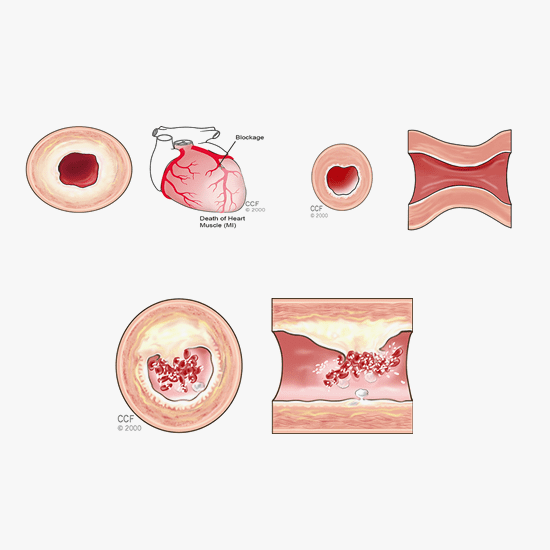
When you have a Heart Attack, blood clots stop the flow of blood down the coronary arteries, which leads to blood not supplying the heart muscle.
Typically, this happens as the plaque in your arteries ruptures, with disc-shaped blood platelets in your coronary arteries sticking together around the rupture, leading to a blockage of your coronary artery.
Just like many heart diseases, there are different types of Heart Attacks:
When plaque builds up and leads to a heart attack:
- Plaque builds up in the artery, reducing blood flow.
- Plaque has continued to build up, and flow is majorly reduced. This can lead to symptoms such as chest pain, back pain, and shortness of breath.
- 100% blockage of the artery and no blood flow; most likely will result in a heart attack.
Different types of Heart Attack
Unstable Angina:
Angina is a condition where your heart muscle has a temporary deprivation of oxygen leading to chest pain and discomfort but is relieved by rest and Angina medication. Unstable Angina is chest pain or discomfort that occurs when one is resting and typically does not go away with medications such as GTN sprays.
Non-ST Elevation Myocardial Infarction (NSTEMI):
If you suffer from a non-STEMI, the damage to your heart muscle may be considered relatively small or temporary in nature.
ST-Elevation Myocardial Infarction:
If you have a STEMI, a large part of your heart muscle has been impacted due to an extended period of reduced blood supply to the heart muscle.
Coronary Spasm:
Coronary spasm is a condition where your coronary arteries can spasm intermittently, leading to reduced blood supply to your heart muscle. If this happens for extended periods of time, it can result in a Heart Attack.
Causes of Heart Attack
The leading cause of a Heart Attack is underlying Coronary Artery Disease. Coronary Artery Disease is where cholesterol deposits build up in your coronary arteries, forming a waxy-like substance called plaque.
Statistics
According to the Victor Chang Institute, around 50 Australian women will die per day of a Heart Attack
It is estimated that 40% of women’s heart attacks are fatal, with many women unaware of what the symptoms are.
Around 56,000 hospitalisations will occur yearly for Heart Attacks.

Signs & symptoms of Heart Attack
The signs and symptoms that women tend to experience when having a Heart Attack are considered ‘atypical’ of normal Heart Attack symptoms.
These are some of the symptom’s women could experience:
Typical symptoms
- Nausea or vomiting
- Abdominal, shoulder, upper back, neck and jaw pain
- Sweating
- Shortness of breath
- Palpitations
- Extreme fatigue
- Light headedness
Please call emergency services if you think you or someone you know is having a heart attack.

Treatment for Heart Attack
It is essential that if you, or a person you know are having a heart attack that you seek immediate medical assistance.
The longer a heart attack progresses for, the less likely the heart muscle can be saved and increases the likelihood of death.
Depending on the nature and severity of your heart attack, you may have a number of different treatments:
Coronary angiogram and stenting
In the coronary angiogram, a balloon (hover over pop-up) will be opened up in your blocked artery to allow blood to flow back to the heart muscle. Once this is achieved, doctors will place a metal stent, which is mesh-like tube that holds open the artery.
Medications
You may be given medications to dissolve clots that have developed in your coronary artery, also known as thrombolytics.
Coronary Bypass Graft Surgery
Also known as CABGs, this surgery is where your own arteries are taken from your arms, legs or chest, reattached to the damaged coronary arteries and allow blood to flow through to the Heart Muscle.
Defibrillators
These may be used to shock your heart back to rhythm if it has stopped or gone into a dangerous rhythm as a result of the Heart Attack.
What you need to know
Karen’s Story